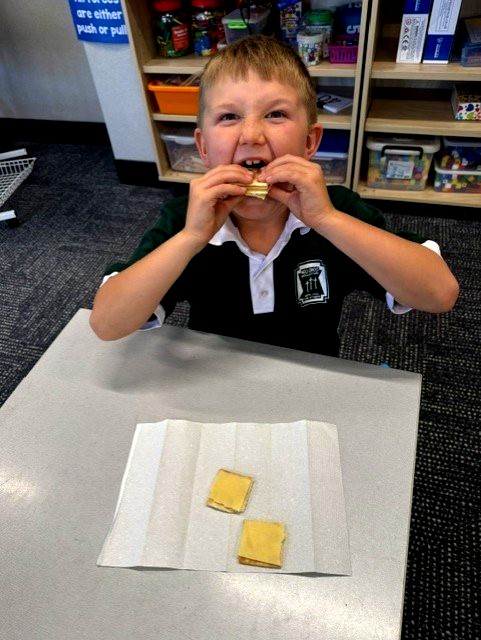
Learning mathematics is about much more than numbers. In the early years of schooling, children develop the foundational understanding that supports future success in mathematics, science, technology and everyday problem-solving. At Holy Cross Primary School, our Year 1 students recently brought this learning to life as they explored halves and quarters through a hands-on lesson that was both engaging and memorable.
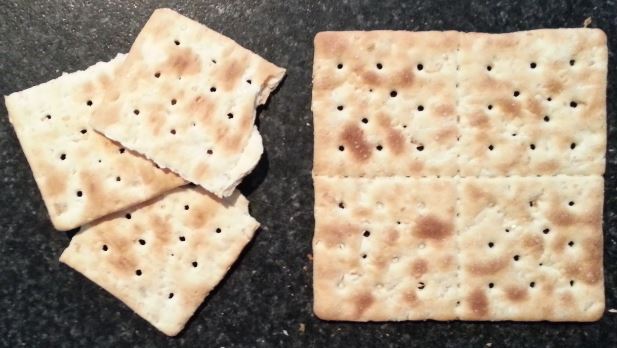
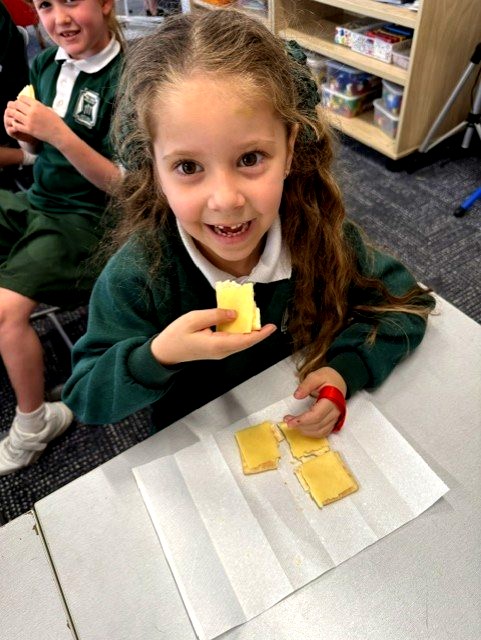
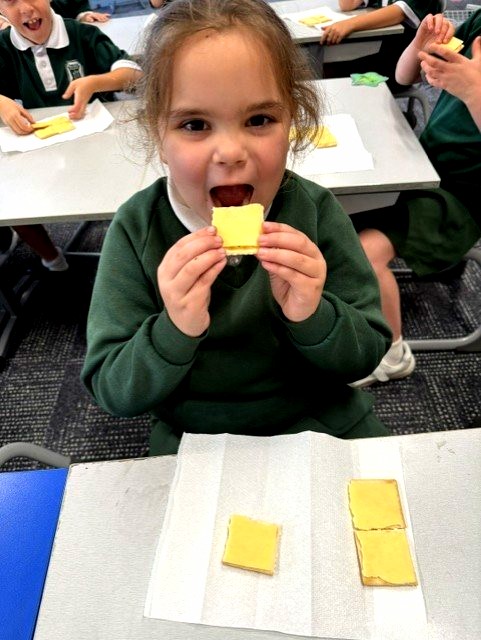
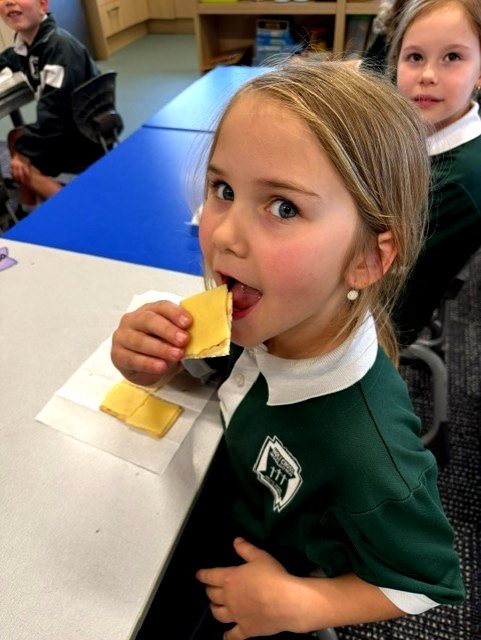
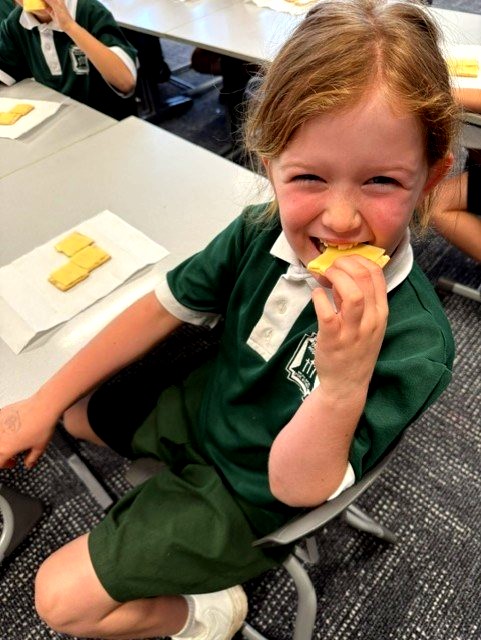
As part of their mathematics learning, Year 1 students investigated how shapes and collections can be divided into equal parts. Using Salada biscuits and slices of cheese, students created halves and quarters, explored how parts can be combined to make a whole, and developed a practical understanding of fractions through concrete experiences. The lesson finished with a well-earned opportunity to enjoy their mathematical creations.
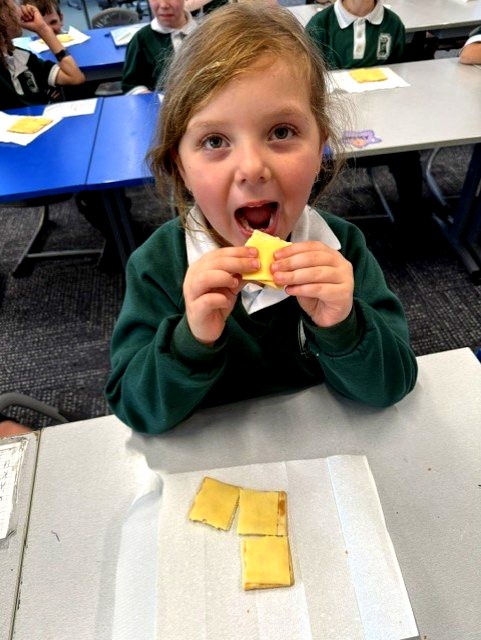
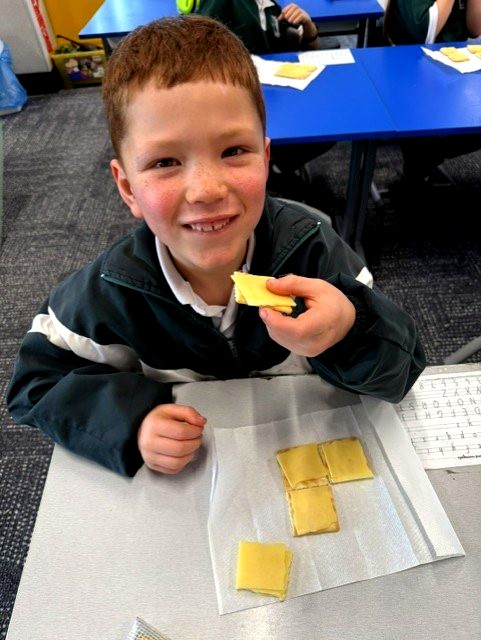
Fractions form an important part of the Australian Curriculum in the early years and help children develop number sense, spatial awareness and mathematical reasoning. Before students can confidently work with more complex fractions in later years, they must first understand that a whole can be partitioned into equal parts and that those parts can be recombined. Learning experiences such as this provide the strong foundations needed for future mathematical success.
At Holy Cross, students in Prep to Year 2 engage with mathematics through a balance of explicit instruction, guided practice and hands-on learning opportunities. Teachers use practical materials and real-world examples to help children develop a deep understanding of key concepts before moving to more abstract mathematical thinking.
Principal Simon Mahaffy says the early years are a critical time for developing confidence and enthusiasm in mathematics.
"Strong foundations in mathematics begin in the early years. When students can see, touch and manipulate materials, they develop a much deeper understanding of mathematical concepts and are more likely to view themselves as capable mathematicians," Mr Mahaffy says.
"Our goal is to help students build confidence alongside competence. We want children to understand not just the answer, but why the answer makes sense."
Research consistently shows that positive early experiences in mathematics contribute to stronger learning outcomes throughout a student's education. Hands-on activities help young learners make meaningful connections between mathematical language, symbols and real-world experiences, allowing them to develop skills that can be applied across different learning areas.
For the Year 1 students, using familiar objects such as biscuits and cheese transformed fractions from an abstract concept into something tangible and enjoyable. As students folded, divided and reconstructed their pieces, they could physically see the relationship between halves, quarters and wholes, strengthening their conceptual understanding.
Mr Mahaffy says opportunities such as this demonstrate the value of contemporary teaching practices that place students at the centre of their learning.
"Children learn best when they are actively engaged in the learning process. Experiences that allow students to investigate, explore and discover help build curiosity and create lasting understanding," he says.
"Mathematics is all around us. By connecting classroom learning to everyday experiences, students begin to recognise the practical value of mathematics and develop skills that will support them throughout their lives."
The Year 1 fraction investigation is just one example of the rich learning experiences taking place every day at Holy Cross Primary School. Through purposeful, engaging and developmentally appropriate teaching, students are building the essential knowledge and skills that will support their learning journey for years to come.
As these young mathematicians discovered, sometimes the best way to understand a fraction is to create it, explore it and, of course, eat it.